 |
Zakładka z wyszukiwarką danych komponentów |
|
|
Zakładka z wyszukiwarką danych komponentów |
|
The question interval is too short.
Please try again in a few seconds.

Hello, Please ask a question about P6KE6V8A-T Datasheet
# Example questions:
➢ What does the graph illustrate regarding peak forward surge current, and what is the x-axis representing?
➢ What packaging options are available for these devices, and what do the suffixes '-b' and '-t' signify?
➢ What is the typical reverse standoff voltage (vrwm) range offered by the devices detailed in the provided datasheet?
| Part No. | P6KE6V8A-T |
| Manufacturer | DIODES |
| Size | 77 Kbytes |
| Pages | 4 pages |
| Description | 600W TRANSIENT VOLTAGE SUPPRESSOR |

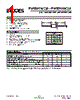
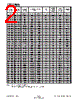

1. Overall Purpose & Series
️· Product: P6KE Series - This is a series of silicon TVS diodes. TVS diodes are used to protect circuits from voltage transients like lightning strikes, inductive switching, and load dumps. They act as a clamp, diverting excess voltage away from the protected device.
️· Target: They are intended for surge protection in a wide range of applications.
️· Bipolar/Unipolar: The datasheets cover both bipolar (standard) and Uni-Directional versions (identified by the `(C)` in the part number, e.g., P6KE6V8(C)A).
2. Key Specifications & Features
️· Voltage Range: The datasheets cover a range of standoff voltages (VWM - Working Voltage) starting from 6.4V and going up to 400V.
️· Peak Pulse Power: This is a critical specification indicating how much energy the diode can handle. The datasheets specify a peak pulse power ranging from 600W to 10000W, depending on the part number.
️· Response Time: TVS diodes need to respond very quickly to transients. These diodes have very fast response times (picoseconds).
️· Capacitance: A key tradeoff with TVS diodes is capacitance, which can affect circuit performance. The datasheets provide capacitance values.
️· Forward Voltage: This is a typical specification for diodes.
️· Reverse Leakage Current: Specifies how much current flows in the reverse direction when no voltage transient is present.
3. Waveforms and Graphs (These provide critical design information!)
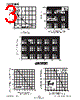
️· Figure 1: Pulse Waveform: Shows a standard pulse waveform used for testing.
️· Figure 2: Typical Total Capacitance: Shows how capacitance varies with the voltage.
️· Figure 4: Pulse Derating Curve: Illustrates how the maximum surge current capability decreases with increasing ambient temperature.
️· Figure 5: Steady-State Power Derating: Shows how the maximum power dissipation decreases with increasing lead temperature.
️· Figure 6: Peak Forward Surge Current vs. Number of Cycles: Shows how the surge current capability changes with the number of surges.
4. Ordering Information
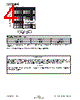
️· Part Numbering System: The part number includes a voltage designation (e.g., 6.4V, 15V, 400V) and a suffix to indicate packaging:
- `-B`: Bulk
- `-T`: Tape & Reel
️· Packaging: Available in DO-15 packages.
️· Website Link: Provides a link for more detailed packaging information.
Important Notes from the Datasheet:
️· Bipolar vs. Uni-Directional: Pay close attention to whether the application requires a bipolar (bidirectional) or unidirectional TVS diode.
️· Derating: Always consider derating the TVS diode’s performance for high temperatures or frequent surges.
️· Application Considerations: This is a specialist document. Proper application of a TVS diode involves careful design to ensure the protected device is effectively shielded from the transient voltage while avoiding negative impacts from the diode's capacitance or clamping characteristics.
1. Overall Purpose & Series
️· Product: P6KE Series - This is a series of silicon TVS diodes. TVS diodes are used to protect circuits from voltage transients like lightning strikes, inductive switching, and load dumps. They act as a clamp, diverting excess voltage away from the protected device.
️· Target: They are intended for surge protection in a wide range of applications.
️· Bipolar/Unipolar: The datasheets cover both bipolar (standard) and Uni-Directional versions (identified by the `(C)` in the part number, e.g., P6KE6V8(C)A).
2. Key Specifications & Features
️· Voltage Range: The datasheets cover a range of standoff voltages (VWM - Working Voltage) starting from 6.4V and going up to 400V.
️· Peak Pulse Power: This is a critical specification indicating how much energy the diode can handle. The datasheets specify a peak pulse power ranging from 600W to 10000W, depending on the part number.
️· Response Time: TVS diodes need to respond very quickly to transients. These diodes have very fast response times (picoseconds).
️· Capacitance: A key tradeoff with TVS diodes is capacitance, which can affect circuit performance. The datasheets provide capacitance values.
️· Forward Voltage: This is a typical specification for diodes.
️· Reverse Leakage Current: Specifies how much current flows in the reverse direction when no voltage transient is present.
3. Waveforms and Graphs (These provide critical design information!)
️· Figure 1: Pulse Waveform: Shows a standard pulse waveform used for testing.
️· Figure 2: Typical Total Capacitance: Shows how capacitance varies with the voltage.
️· Figure 4: Pulse Derating Curve: Illustrates how the maximum surge current capability decreases with increasing ambient temperature.
️· Figure 5: Steady-State Power Derating: Shows how the maximum power dissipation decreases with increasing lead temperature.
️· Figure 6: Peak Forward Surge Current vs. Number of Cycles: Shows how the surge current capability changes with the number of surges.
4. Ordering Information
️· Part Numbering System: The part number includes a voltage designation (e.g., 6.4V, 15V, 400V) and a suffix to indicate packaging:
- `-B`: Bulk
- `-T`: Tape & Reel
️· Packaging: Available in DO-15 packages.
️· Website Link: Provides a link for more detailed packaging information.
Important Notes from the Datasheet:
️· Bipolar vs. Uni-Directional: Pay close attention to whether the application requires a bipolar (bidirectional) or unidirectional TVS diode.
️· Derating: Always consider derating the TVS diode’s performance for high temperatures or frequent surges.
️· Application Considerations: This is a specialist document. Proper application of a TVS diode involves careful design to ensure the protected device is effectively shielded from the transient voltage while avoiding negative impacts from the diode's capacitance or clamping characteristics.
| Part No. | P6KE6V8A-T |
| Manufacturer | DIODES |
| Size | 77 Kbytes |
| Pages | 4 pages |
| Description | 600W TRANSIENT VOLTAGE SUPPRESSOR |
| Czy Alldatasheet okazała się pomocna? [ DONATE ] |
O Alldatasheet | Reklama | Kontakt | Polityka prywatności | Link do karty katalogowej | Linki | Lista producentów All Rights Reserved©Alldatasheet.com |
| Russian : Alldatasheetru.com | Korean : Alldatasheet.co.kr | Spanish : Alldatasheet.es | French : Alldatasheet.fr | Italian : Alldatasheetit.com Portuguese : Alldatasheetpt.com | Polish : Alldatasheet.pl | Vietnamese : Alldatasheet.vn Indian : Alldatasheet.in | Mexican : Alldatasheet.com.mx | British : Alldatasheet.co.uk | New Zealand : Alldatasheet.co.nz |
|
Family Site : ic2ic.com |
icmetro.com |
 Polish ▼
  English
 Chinese
 German
 Japanese
 Russian
 Korean
 Spanish
 French
 Italian
 Portuguese
 Vietnamese
 Indian
 Mexican
 British
 New Zealand