 |
Zakładka z wyszukiwarką danych komponentów |
|
|
Zakładka z wyszukiwarką danych komponentów |
|
The question interval is too short.
Please try again in a few seconds.

Hello, Please ask a question about AMS1117 Datasheet
# Example questions:
➢ What is the typical minimum operating current for the adjustable ams1117 device, according to the datasheet?
➢ What is the thermal resistance from junction to ambient achievable with a 2500 sq. mm copper area on both the top and back sides of the board?
➢ What component value is suggested for the adjust pin bypass capacitor at a ripple frequency of 10khz to achieve optimal ripple rejection, based on the datasheet recommendations?
| Part No. | AMS1117 |
| Manufacturer | ADMOS |
| Size | 185 Kbytes |
| Pages | 8 pages |
| Description | 1A LOW DROPOUT VOLTAGE REGULATOR |

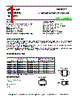


Okay, here's a breakdown of the information from the provided document, organized for clarity and key takeaways.
1. Product: AMS1117 Voltage Regulator
️· Type: Three-terminal adjustable voltage regulator.
️· Function: Provides a stable output voltage.
2. Key Features & Specifications
️· Adjustable Output: Output voltage is set using external resistors.
️· Reference Voltage: 1.25V between the output and adjust terminals.
️· Minimum Operating Current: 10mA (important for setting the output voltage – a constant current flows through external resistors).
️· Short-Circuit Current: (Data provided in a graph).
️· Ripple Rejection: Performance depends on bypassing the adjust pin (requires capacitor at appropriate frequency).
️· Thermal Protection: Internal limiting circuitry, but maximum junction temperature (125°C) must not be exceeded.
️· Thermal Resistance: 15°C/W (junction to tab), influenced by PC board and copper area.
️· Typical Performance Characteristics: Graphs illustrating short circuit current and ripple rejection.
3. Circuit Design & Application Notes
️· Output Voltage Calculation: `V_OUT = V_REF (1 + R2/R1) + I_ADJ * R2`
️· Load Regulation: Best achieved when R1 is connected to the regulator's case, not directly to the load.
️· Remote Load Sensing: Not truly possible with this three-terminal regulator due to inherent limitations.
️· Bypass Capacitor: Essential for adjusting pin to optimize ripple rejection.
️· Thermal Management: Copper area on the PC board significantly impacts heat dissipation and junction temperature.
️· Power Dissipation: `P_D = (V_IN - V_OUT) * I_OUT`
4. Important Considerations & Best Practices
️· Resistor Selection: R1 and R2 directly influence output voltage and require consideration of minimum operating current (10mA).
️· PCB Layout: Proper copper area is crucial for thermal management and preventing overheating. Consider both top and bottom layer copper.
️· Bypassing: Use a capacitor on the adjust pin for optimal ripple rejection.
️· Thermal Resistance Calculation: Accurate estimation and management are necessary to stay within the maximum junction temperature limit (125°C).
Let me know if you'd like me to focus on a particular aspect or have any follow-up questions!
1. Product: AMS1117 Voltage Regulator
️· Type: Three-terminal adjustable voltage regulator.
️· Function: Provides a stable output voltage.
2. Key Features & Specifications
️· Adjustable Output: Output voltage is set using external resistors.
️· Reference Voltage: 1.25V between the output and adjust terminals.
️· Minimum Operating Current: 10mA (important for setting the output voltage – a constant current flows through external resistors).
️· Short-Circuit Current: (Data provided in a graph).
️· Ripple Rejection: Performance depends on bypassing the adjust pin (requires capacitor at appropriate frequency).
️· Thermal Protection: Internal limiting circuitry, but maximum junction temperature (125°C) must not be exceeded.
️· Thermal Resistance: 15°C/W (junction to tab), influenced by PC board and copper area.
️· Typical Performance Characteristics: Graphs illustrating short circuit current and ripple rejection.
3. Circuit Design & Application Notes
️· Output Voltage Calculation: `V_OUT = V_REF (1 + R2/R1) + I_ADJ * R2`
️· Load Regulation: Best achieved when R1 is connected to the regulator's case, not directly to the load.
️· Remote Load Sensing: Not truly possible with this three-terminal regulator due to inherent limitations.
️· Bypass Capacitor: Essential for adjusting pin to optimize ripple rejection.
️· Thermal Management: Copper area on the PC board significantly impacts heat dissipation and junction temperature.
️· Power Dissipation: `P_D = (V_IN - V_OUT) * I_OUT`
4. Important Considerations & Best Practices
️· Resistor Selection: R1 and R2 directly influence output voltage and require consideration of minimum operating current (10mA).
️· PCB Layout: Proper copper area is crucial for thermal management and preventing overheating. Consider both top and bottom layer copper.
️· Bypassing: Use a capacitor on the adjust pin for optimal ripple rejection.
️· Thermal Resistance Calculation: Accurate estimation and management are necessary to stay within the maximum junction temperature limit (125°C).
| Part No. | AMS1117 |
| Manufacturer | ADMOS |
| Size | 185 Kbytes |
| Pages | 8 pages |
| Description | 1A LOW DROPOUT VOLTAGE REGULATOR |
| Czy Alldatasheet okazała się pomocna? [ DONATE ] |
O Alldatasheet | Reklama | Kontakt | Polityka prywatności | Link do karty katalogowej | Linki | Lista producentów All Rights Reserved©Alldatasheet.com |
| Russian : Alldatasheetru.com | Korean : Alldatasheet.co.kr | Spanish : Alldatasheet.es | French : Alldatasheet.fr | Italian : Alldatasheetit.com Portuguese : Alldatasheetpt.com | Polish : Alldatasheet.pl | Vietnamese : Alldatasheet.vn Indian : Alldatasheet.in | Mexican : Alldatasheet.com.mx | British : Alldatasheet.co.uk | New Zealand : Alldatasheet.co.nz |
|
Family Site : ic2ic.com |
icmetro.com |
 Polish ▼
  English
 Chinese
 German
 Japanese
 Russian
 Korean
 Spanish
 French
 Italian
 Portuguese
 Vietnamese
 Indian
 Mexican
 British
 New Zealand