 |
Zakładka z wyszukiwarką danych komponentów |
|
|
Zakładka z wyszukiwarką danych komponentów |
|
The question interval is too short.
Please try again in a few seconds.

Hello, Please ask a question about LTC1647-1_15 Datasheet
# Example questions:
➢ How does increasing the temperature affect the gate output source current?
➢ What is the typical value of v_gate at 25°c when v_cc1 = v_cc2 = 5v?
➢ What is the relationship between v_cc2 and v_gate1 as demonstrated in the 'v_gate1 vs v_cc2' graph?
| Part No. | LTC1647-1_15 |
| Manufacturer | LINER |
| Size | 244 Kbytes |
| Pages | 22 pages |
| Description | Dual Hot Swap Controllers |


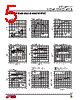


Okay, let's break down this LTC1647 datasheet extract. I've consolidated the key information into a more digestible format.
1. Device Overview:
️· Part Number: LTC1647 (Available in three versions: LTC1647-1, LTC1647-2, and LTC1647-3)
️· Function: It's a synchronous buck regulator controller, specifically designed for driving external MOSFETs. It controls the switching action to efficiently regulate voltage.
2. Key Features (Inferred from Data):
️· Synchronous Operation: Uses synchronous rectification, meaning a MOSFET acts as a rectifier, improving efficiency.
️· Adjustable Output Voltage: Output voltage is configurable.
️· Wide Input Voltage Range: Handles a broad range of input voltages (likely 4.5V - 40V, based on various charts).
️· Internal Compensation: Simplifies design by including internal compensation circuitry.
️· Soft-Start: Provides a controlled start-up to prevent inrush current.
️· External MOSFET Control: The controller drives external MOSFETs for power delivery.
️· Current Limiting: Has a current limit feature for protection.
️· Automatic Pulse Skipping (APS): A power saving mode for light loads.
️· Short-Circuit Protection: Protects the circuit from short-circuit conditions.
3. Datasheet Sections Breakdown (Based on Figures/Graphs):
️· I-V Characteristics: Shows relationships between input/output voltages and currents, helping to understand power conversion efficiency.
️· Efficiency vs Load Current: Graphs display the regulator's efficiency across different load currents. Efficiency is highest at moderate loads and decreases at very light or very heavy loads.
️· V<sub>GATE</sub> vs. V<sub>CC</sub> Shows the gate drive voltage (used to switch the MOSFET) in relation to the controller's supply voltage.
️· Temperature vs. Voltage: Illustrates how the output voltage changes with temperature. This is important for thermal design and ensuring stability.
️· Output Voltage vs. Temperature: Details the behavior of the output voltage at different temperature ranges.
️· Efficiency graphs Demonstrate the controller's power efficiency as a function of load current, input voltage and output voltage.
4. Important Notes & Potential Design Considerations:
️· External Components: The LTC1647 is a *controller*. You're responsible for selecting and connecting external MOSFETs, inductors, capacitors, and resistors. The datasheet provides guidance, but specific choices depend on your application's requirements.
️· Compensation: Although internal compensation exists, fine-tuning external components may be needed for optimal performance and stability.
️· Thermal Management: Careful attention to heatsinking and thermal design is vital, especially at higher power levels.
️· Gate Drive Voltage (V<sub>GATE</sub>): Pay close attention to the gate drive voltage. Ensure sufficient drive to fully switch the MOSFETs.
️· MOSFET Selection: The selection of suitable MOSFETs (on resistance, gate charge, etc.) is crucial for efficiency and overall performance.
Let me know if you have specific questions about a particular figure or aspect of the datasheet, or if you want me to elaborate on any of these points!
1. Device Overview:
️· Part Number: LTC1647 (Available in three versions: LTC1647-1, LTC1647-2, and LTC1647-3)
️· Function: It's a synchronous buck regulator controller, specifically designed for driving external MOSFETs. It controls the switching action to efficiently regulate voltage.
2. Key Features (Inferred from Data):
️· Synchronous Operation: Uses synchronous rectification, meaning a MOSFET acts as a rectifier, improving efficiency.
️· Adjustable Output Voltage: Output voltage is configurable.
️· Wide Input Voltage Range: Handles a broad range of input voltages (likely 4.5V - 40V, based on various charts).
️· Internal Compensation: Simplifies design by including internal compensation circuitry.
️· Soft-Start: Provides a controlled start-up to prevent inrush current.
️· External MOSFET Control: The controller drives external MOSFETs for power delivery.
️· Current Limiting: Has a current limit feature for protection.
️· Automatic Pulse Skipping (APS): A power saving mode for light loads.
️· Short-Circuit Protection: Protects the circuit from short-circuit conditions.
3. Datasheet Sections Breakdown (Based on Figures/Graphs):
️· I-V Characteristics: Shows relationships between input/output voltages and currents, helping to understand power conversion efficiency.
️· Efficiency vs Load Current: Graphs display the regulator's efficiency across different load currents. Efficiency is highest at moderate loads and decreases at very light or very heavy loads.
️· V<sub>GATE</sub> vs. V<sub>CC</sub> Shows the gate drive voltage (used to switch the MOSFET) in relation to the controller's supply voltage.
️· Temperature vs. Voltage: Illustrates how the output voltage changes with temperature. This is important for thermal design and ensuring stability.
️· Output Voltage vs. Temperature: Details the behavior of the output voltage at different temperature ranges.
️· Efficiency graphs Demonstrate the controller's power efficiency as a function of load current, input voltage and output voltage.
4. Important Notes & Potential Design Considerations:
️· External Components: The LTC1647 is a *controller*. You're responsible for selecting and connecting external MOSFETs, inductors, capacitors, and resistors. The datasheet provides guidance, but specific choices depend on your application's requirements.
️· Compensation: Although internal compensation exists, fine-tuning external components may be needed for optimal performance and stability.
️· Thermal Management: Careful attention to heatsinking and thermal design is vital, especially at higher power levels.
️· Gate Drive Voltage (V<sub>GATE</sub>): Pay close attention to the gate drive voltage. Ensure sufficient drive to fully switch the MOSFETs.
️· MOSFET Selection: The selection of suitable MOSFETs (on resistance, gate charge, etc.) is crucial for efficiency and overall performance.
| Part No. | LTC1647-1_15 |
| Manufacturer | LINER |
| Size | 244 Kbytes |
| Pages | 22 pages |
| Description | Dual Hot Swap Controllers |
| Czy Alldatasheet okazała się pomocna? [ DONATE ] |
O Alldatasheet | Reklama | Kontakt | Polityka prywatności | Link do karty katalogowej | Linki | Lista producentów All Rights Reserved©Alldatasheet.com |
| Russian : Alldatasheetru.com | Korean : Alldatasheet.co.kr | Spanish : Alldatasheet.es | French : Alldatasheet.fr | Italian : Alldatasheetit.com Portuguese : Alldatasheetpt.com | Polish : Alldatasheet.pl | Vietnamese : Alldatasheet.vn Indian : Alldatasheet.in | Mexican : Alldatasheet.com.mx | British : Alldatasheet.co.uk | New Zealand : Alldatasheet.co.nz |
|
Family Site : ic2ic.com |
icmetro.com |
 Polish ▼
  English
 Chinese
 German
 Japanese
 Russian
 Korean
 Spanish
 French
 Italian
 Portuguese
 Vietnamese
 Indian
 Mexican
 British
 New Zealand