 |
Zakładka z wyszukiwarką danych komponentów |
|
|
Zakładka z wyszukiwarką danych komponentów |
|
The question interval is too short.
Please try again in a few seconds.

Hello, Please ask a question about LTM4602 Datasheet
# Example questions:
➢ What are the minimum and maximum recommended output capacitance values (cout) when the output current (iout) is 6a?
➢ What is the purpose of the 'fadj' pin, and how does adjusting a resistor connected to it affect the switching frequency?
➢ What happens to the pgood signal when the output voltage is within 10% of its nominal value?
| Part No. | LTM4602 |
| Manufacturer | LINER |
| Size | 327 Kbytes |
| Pages | 24 pages |
| Description | 6A High Effi ciency DC/DC 關Module |


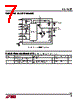


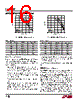
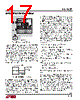

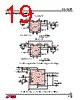
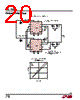
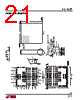
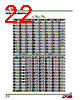
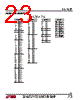

1. Overview
️· Device: LTM4602 (Synchronous Buck DC-DC Converter)
️· Function: A monolithic synchronous buck DC-DC converter.
️· Purpose: Designed for compact, high-efficiency power conversion applications.
2. Key Features & Benefits
️· Wide Input Range: 4.5V to 20V
️· Output Voltage: Programmable (typically 1.5V)
️· Maximum Output Current: 6A
️· Synchronous Operation: Improved efficiency due to integrated MOSFETs.
️· Compact Size: Monolithic design minimizes external component count.
️· Programmable Switching Frequency: Adjustable through an external resistor on the fADJ pin. Typically 850kHz.
️· Forced Continuous or Discontinuous Mode: Controlled via the FCB pin.
️· Power Good Indication: PGOOD pin provides output voltage status.
️· Soft-Start: Limits inrush current during startup.
️· Shutdown Capability: RUN/SS pin allows for enabling/disabling the converter.
3. Pin Functions
️· V<sub>IN</sub> (Bank 1): Input power pins – requires decoupling capacitors.
️· f<sub>ADJ</sub> (Pin A15): Adjusts the switching frequency; a resistor sets the one-shot timer current.
️· SV<sub>IN</sub> (Pin A17): Supply for internal PWM controller; add decoupling capacitance.
️· EXTV<sub>CC</sub> (Pin A19): External 5V supply; reduces power loss if input voltage is higher. Must not exceed V<sub>IN</sub>.
️· V<sub>OSET</sub> (Pin A21): Negative input of the error amplifier; programmable output voltage.
️· COMP (Pin B23): Current comparator threshold and error amplifier compensation point.
️· SGND (Pin D23): Signal ground; connects to PGND.
️· RUN/SS (Pin F23): Enables/disables converter and provides soft-start.
️· FCB (Pin G23): Controls continuous or discontinuous mode.
️· PGOOD (Pin J23): Output voltage power good indicator.
️· PGND (Bank 2): Power ground pins.
️· V<sub>OUT</sub> (Bank 3): Output power pins; requires decoupling capacitors.
4. Decoupling Requirements
️· C<sub>IN</sub> (Input Capacitor): > 20µF (at 25°C, 12V input)
️· C<sub>OUT</sub> (Output Capacitor): 100-200µF (refer to application information for specific recommendations)
5. Important Considerations
️· EXTV<sub>CC</sub> Voltage: Must be lower than the input voltage (V<sub>IN</sub>).
️· Soft-Start: Internal capacitor provides 0.7ms soft-start; additional capacitance on RUN/SS can extend this.
️· Shutdown: Forcing RUN/SS below 0.8V disables the converter.
️· FCB Pin: Grounds for forced continuous mode, tie above 0.63V to enable discontinuous mode.
1. Overview
️· Device: LTM4602 (Synchronous Buck DC-DC Converter)
️· Function: A monolithic synchronous buck DC-DC converter.
️· Purpose: Designed for compact, high-efficiency power conversion applications.
2. Key Features & Benefits
️· Wide Input Range: 4.5V to 20V
️· Output Voltage: Programmable (typically 1.5V)
️· Maximum Output Current: 6A
️· Synchronous Operation: Improved efficiency due to integrated MOSFETs.
️· Compact Size: Monolithic design minimizes external component count.
️· Programmable Switching Frequency: Adjustable through an external resistor on the fADJ pin. Typically 850kHz.
️· Forced Continuous or Discontinuous Mode: Controlled via the FCB pin.
️· Power Good Indication: PGOOD pin provides output voltage status.
️· Soft-Start: Limits inrush current during startup.
️· Shutdown Capability: RUN/SS pin allows for enabling/disabling the converter.
3. Pin Functions
️· V<sub>IN</sub> (Bank 1): Input power pins – requires decoupling capacitors.
️· f<sub>ADJ</sub> (Pin A15): Adjusts the switching frequency; a resistor sets the one-shot timer current.
️· SV<sub>IN</sub> (Pin A17): Supply for internal PWM controller; add decoupling capacitance.
️· EXTV<sub>CC</sub> (Pin A19): External 5V supply; reduces power loss if input voltage is higher. Must not exceed V<sub>IN</sub>.
️· V<sub>OSET</sub> (Pin A21): Negative input of the error amplifier; programmable output voltage.
️· COMP (Pin B23): Current comparator threshold and error amplifier compensation point.
️· SGND (Pin D23): Signal ground; connects to PGND.
️· RUN/SS (Pin F23): Enables/disables converter and provides soft-start.
️· FCB (Pin G23): Controls continuous or discontinuous mode.
️· PGOOD (Pin J23): Output voltage power good indicator.
️· PGND (Bank 2): Power ground pins.
️· V<sub>OUT</sub> (Bank 3): Output power pins; requires decoupling capacitors.
4. Decoupling Requirements
️· C<sub>IN</sub> (Input Capacitor): > 20µF (at 25°C, 12V input)
️· C<sub>OUT</sub> (Output Capacitor): 100-200µF (refer to application information for specific recommendations)
5. Important Considerations
️· EXTV<sub>CC</sub> Voltage: Must be lower than the input voltage (V<sub>IN</sub>).
️· Soft-Start: Internal capacitor provides 0.7ms soft-start; additional capacitance on RUN/SS can extend this.
️· Shutdown: Forcing RUN/SS below 0.8V disables the converter.
️· FCB Pin: Grounds for forced continuous mode, tie above 0.63V to enable discontinuous mode.
| Part No. | LTM4602 |
| Manufacturer | LINER |
| Size | 327 Kbytes |
| Pages | 24 pages |
| Description | 6A High Effi ciency DC/DC 關Module |
| Czy Alldatasheet okazała się pomocna? [ DONATE ] |
O Alldatasheet | Reklama | Kontakt | Polityka prywatności | Link do karty katalogowej | Linki | Lista producentów All Rights Reserved©Alldatasheet.com |
| Russian : Alldatasheetru.com | Korean : Alldatasheet.co.kr | Spanish : Alldatasheet.es | French : Alldatasheet.fr | Italian : Alldatasheetit.com Portuguese : Alldatasheetpt.com | Polish : Alldatasheet.pl | Vietnamese : Alldatasheet.vn Indian : Alldatasheet.in | Mexican : Alldatasheet.com.mx | British : Alldatasheet.co.uk | New Zealand : Alldatasheet.co.nz |
|
Family Site : ic2ic.com |
icmetro.com |
 Polish ▼
  English
 Chinese
 German
 Japanese
 Russian
 Korean
 Spanish
 French
 Italian
 Portuguese
 Vietnamese
 Indian
 Mexican
 British
 New Zealand