|
Zakładka z wyszukiwarką danych komponentów |
|
|
Zakładka z wyszukiwarką danych komponentów |
|
LM62 Arkusz danych(PDF) 5 Page - National Semiconductor (TI) |
|
|
|
|||||||||||||||||||||||||||||
LM62 Arkusz danych(HTML) 5 Page - National Semiconductor (TI) |
|
|
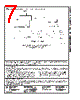
5 / 7 page  1.0 Mounting The LM62 can be applied easily in the same way as other integrated-circuit temperature sensors. It can be glued or cemented to a surface. The temperature that the LM62 is sensing will be within about +0.2˚C of the surface tempera- ture that LM62’s leads are attached to. This presumes that the ambient air temperature is almost the same as the surface temperature; if the air temperature were much higher or lower than the surface temperature, the actual temperature measured would be at an intermediate temperature between the surface temperature and the air temperature. To ensure good thermal conductivity the backside of the LM62 die is directly attached to the GND pin. The lands and traces to the LM62 will, of course, be part of the printed circuit board, which is the object whose temperature is being measured. These printed circuit board lands and traces will not cause the LM62’s temperature to deviate from the de- sired temperature. Alternatively, the LM62 can be mounted inside a sealed-end metal tube, and can then be dipped into a bath or screwed into a threaded hole in a tank. As with any IC, the LM62 and accompanying wiring and circuits must be kept insulated and dry, to avoid leakage and corrosion. This is especially true if the circuit may operate at cold temperatures where conden- sation can occur. Printed-circuit coatings and varnishes such as Humiseal and epoxy paints or dips are often used to ensure that moisture cannot corrode the LM62 or its connec- tions. The thermal resistance junction to ambient ( θ JA) is the pa- rameter used to calculate the rise of a device junction tem- perature due to its power dissipation. For the LM62 the equation used to calculate the rise in the die temperature is as follows: T J =TA + θ JA [(+VS IQ) + (+VS −VO)IL] where I Q is the quiescent current and ILis the load current on the output. Since the LM62’s junction temperature is the actual temperature being measured care should be taken to minimize the load current that the LM62 is required to drive. The table shown in Figure 3 summarizes the rise in die temperature of the LM62 without any loading, and the ther- mal resistance for different conditions. 2.0 Capacitive Loads The LM62 handles capacitive loading well. Without any spe- cial precautions, the LM62 can drive any capacitive load as shown in Figure 4. Over the specified temperature range the LM62 has a maximum output impedance of 4.7 k Ω.Inan extremely noisy environment it may be necessary to add some filtering to minimize noise pickup. It is recommended that 0.1 µF be added from +V S to GND to bypass the power supply voltage, as shown in Figure 5. In a noisy environment it may be necessary to add a capacitor from the output to ground. A 1 µF output capacitor with the 4.7 k Ω maximum output impedance will form a 34 Hz lowpass filter. Since the thermal time constant of the LM62 is much slower than the 30 ms time constant formed by the RC, the overall response time of the LM62 will not be significantly affected. For much larger capacitors this additional time lag will increase the overall response time of the LM62. SOT-23 SOT-23 no heat sink small heat fin (Note 13) (Note 12) θ JA T J −TA θ JA T J −TA (˚C/W) (˚C) (˚C/W) (˚C) Still air 450 0.17 260 0.1 Moving air 180 0.07 Note 12: Heat sink used is 1⁄2" square printed circuit board with 2 oz. foil with part attached as shown in Figure 2 . Note 13: Part soldered to 30 gauge wire. FIGURE 3. Temperature Rise of LM62 Due to Self-Heating and Thermal Resistance ( θ JA) 10089315 FIGURE 4. LM62 No Decoupling Required for Capacitive Load 10089316 FIGURE 5. LM62 with Filter for Noisy Environment www.national.com 5 |
|
|
Link URL |
| Czy Alldatasheet okazała się pomocna? [ DONATE ] |
O Alldatasheet | Reklama | Kontakt | Polityka prywatności | Link do karty katalogowej | Linki | Lista producentów All Rights Reserved©Alldatasheet.com |
| Russian : Alldatasheetru.com | Korean : Alldatasheet.co.kr | Spanish : Alldatasheet.es | French : Alldatasheet.fr | Italian : Alldatasheetit.com Portuguese : Alldatasheetpt.com | Polish : Alldatasheet.pl | Vietnamese : Alldatasheet.vn Indian : Alldatasheet.in | Mexican : Alldatasheet.com.mx | British : Alldatasheet.co.uk | New Zealand : Alldatasheet.co.nz |
|
Family Site : ic2ic.com |
icmetro.com |
 Polish ▼
 English
 Chinese
 German
 Japanese
 Russian
 Korean
 Spanish
 French
 Italian
 Portuguese
 Polish
 Vietnamese
 Indian
 Mexican
 British
 New Zealand