 |
Zakładka z wyszukiwarką danych komponentów |
|
|
Zakładka z wyszukiwarką danych komponentów |
|
The question interval is too short.
Please try again in a few seconds.

Hello, Please ask a question about ELM822 Datasheet
# Example questions:
➢ The datasheet includes several graphs showing 'isink-vout' and 'isource-vout' at different vdd levels. what do these graphs indicate about the output drive capability of the amplifier?
➢ How does increasing the supply voltage (vdd) generally affect the common mode rejection ratio (cmrr)?
➢ What is the approximate maximum output voltage (vout) achievable with a 10kω load when the supply voltage (vdd) is 5v?
| Part No. | ELM822 |
| Manufacturer | ELM-TECH |
| Size | 1Mb |
| Pages | 10 pages |
| Description | 1.5關A Very low power CMOS operational amplifier |


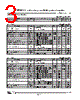


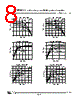


Okay, I'm summarizing the information from the provided document. This is a datasheet for the ELM822xA operational amplifier.
Key Features and Specifications:
️· Technology: CMOS
️· Supply Voltage: (Vdd) Typically operating between 1.2V to 6.0V.
️· Quiescent Current: Very low (implied to be in the microampere range; specific value not directly stated, but a key selling point).
️· Input Offset Voltage: (Not directly stated, but likely low given the technology.)
️· Gain-Bandwidth Product: (Not directly stated, but will vary with supply voltage)
️· Slew Rate: Varies with supply voltage (graphs included). Around 2.0 V/μs at Vdd=1.5V.
️· Short Circuit Current: Increases with Vdd.
️· Maximum/Minimum Output Voltage (Vout): Depend on the load resistor (RL) and supply voltage (Vdd). Graphs provided to illustrate.
️· Pulse Response: Provided for Vdd=1.5V and Vdd=3.0V.
️· CMRR (Common-Mode Rejection Ratio): Varies with Vcm (Common-Mode Voltage). Graphs provided for various supply voltages.
️· PSRR (Power Supply Rejection Ratio): Varies with frequency. Graphs provided for various supply voltages.
Key Graphs and Data Highlights (These are trends - specific numbers are in the graphs):
️· Isource/Isink vs. Vout: Shows the output current capabilities at different Vout values for different Vdd.
️· Maximum Vout vs. RL: Illustrates the maximum output voltage achievable with different load resistors at various supply voltages.
️· Minimum Vout vs. RL: Illustrates the minimum output voltage achievable with different load resistors at various supply voltages.
️· Pulse Response: Illustrates the output response to a pulse signal.
️· CMRR: The CMRR varies depending on the common-mode voltage.
️· PSRR: The PSRR varies with frequency.
️· Slew Rate: The slew rate decreases with decreasing supply voltage and increasing frequency.
Note: To get precise numerical values, you would need to refer to the graphs in the datasheet. This summary is based on the trends presented.
Key Features and Specifications:
️· Technology: CMOS
️· Supply Voltage: (Vdd) Typically operating between 1.2V to 6.0V.
️· Quiescent Current: Very low (implied to be in the microampere range; specific value not directly stated, but a key selling point).
️· Input Offset Voltage: (Not directly stated, but likely low given the technology.)
️· Gain-Bandwidth Product: (Not directly stated, but will vary with supply voltage)
️· Slew Rate: Varies with supply voltage (graphs included). Around 2.0 V/μs at Vdd=1.5V.
️· Short Circuit Current: Increases with Vdd.
️· Maximum/Minimum Output Voltage (Vout): Depend on the load resistor (RL) and supply voltage (Vdd). Graphs provided to illustrate.
️· Pulse Response: Provided for Vdd=1.5V and Vdd=3.0V.
️· CMRR (Common-Mode Rejection Ratio): Varies with Vcm (Common-Mode Voltage). Graphs provided for various supply voltages.
️· PSRR (Power Supply Rejection Ratio): Varies with frequency. Graphs provided for various supply voltages.
Key Graphs and Data Highlights (These are trends - specific numbers are in the graphs):
️· Isource/Isink vs. Vout: Shows the output current capabilities at different Vout values for different Vdd.
️· Maximum Vout vs. RL: Illustrates the maximum output voltage achievable with different load resistors at various supply voltages.
️· Minimum Vout vs. RL: Illustrates the minimum output voltage achievable with different load resistors at various supply voltages.
️· Pulse Response: Illustrates the output response to a pulse signal.
️· CMRR: The CMRR varies depending on the common-mode voltage.
️· PSRR: The PSRR varies with frequency.
️· Slew Rate: The slew rate decreases with decreasing supply voltage and increasing frequency.
| Part No. | ELM822 |
| Manufacturer | ELM-TECH |
| Size | 1Mb |
| Pages | 10 pages |
| Description | 1.5關A Very low power CMOS operational amplifier |
| Czy Alldatasheet okazała się pomocna? [ DONATE ] |
O Alldatasheet | Reklama | Kontakt | Polityka prywatności | Link do karty katalogowej | Linki | Lista producentów All Rights Reserved©Alldatasheet.com |
| Russian : Alldatasheetru.com | Korean : Alldatasheet.co.kr | Spanish : Alldatasheet.es | French : Alldatasheet.fr | Italian : Alldatasheetit.com Portuguese : Alldatasheetpt.com | Polish : Alldatasheet.pl | Vietnamese : Alldatasheet.vn Indian : Alldatasheet.in | Mexican : Alldatasheet.com.mx | British : Alldatasheet.co.uk | New Zealand : Alldatasheet.co.nz |
|
Family Site : ic2ic.com |
icmetro.com |
 Polish ▼
  English
 Chinese
 German
 Japanese
 Russian
 Korean
 Spanish
 French
 Italian
 Portuguese
 Vietnamese
 Indian
 Mexican
 British
 New Zealand